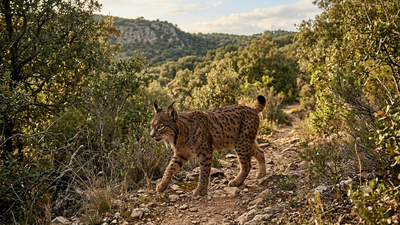
For much of the 20th century, the Iberian lynx was disappearing from the Spanish landscape. By 2001, only 62 mature animals were recorded, leaving one of Europe’s most distinctive wild cats perilously close to extinction. Since then, a sustained conservation programme has altered its trajectory. Reintroductions, captive breeding, habitat restoration and efforts to protect its main prey have helped the population expand into areas where the species had vanished. By 2022, the number of mature Iberian lynx had risen to 648, while the total population, including younger animals, was estimated to have passed 2,000. The improvement has now been reflected in its status on the IUCN Red List, although the species remains far from fully recovered.
The decline of a predator once found across the Iberian Peninsula
The Iberian lynx, Lynx pardinus, is native to the Iberian Peninsula and depends heavily on Mediterranean landscapes where its principal prey, the European rabbit, is available. As suitable habitat became fragmented and rabbit numbers were affected by disease and changes in land use, the lynx lost both territory and access to food.The scale of the decline became especially clear at the beginning of this century. In 2001, just 62 mature individuals were recorded. At that point, extinction was not a distant possibility. The species had already disappeared from large parts of its former range.Concern over its future had been building for years. A 2009 assessment from the IUCN Centre for Mediterranean Cooperation had already highlighted the need for conservation action for Mediterranean mammals, including species facing severe population losses.What followed was not one single intervention, but a collection of measures carried out over many years.
How captive breeding helped return lynx to the wild
Some populations could not recover simply by protecting the animals that remained. The lynx also needed to return to places where it had disappeared. Reintroduction programmes helped establish animals in suitable areas, while captive breeding supplied lynx for release into the wild. Moving individuals between populations also became part of the strategy, helping to broaden the genetic base of groups that had become isolated.Captive breeding was particularly important because the remaining wild population had been reduced to such a small number. With so few animals spread across fragmented areas, natural dispersal alone could not easily rebuild a healthy population.The approach gradually changed the distribution of the species. Areas that had once been empty of Iberian lynx could once again support them.
Why rabbit populations became central to lynx conservation
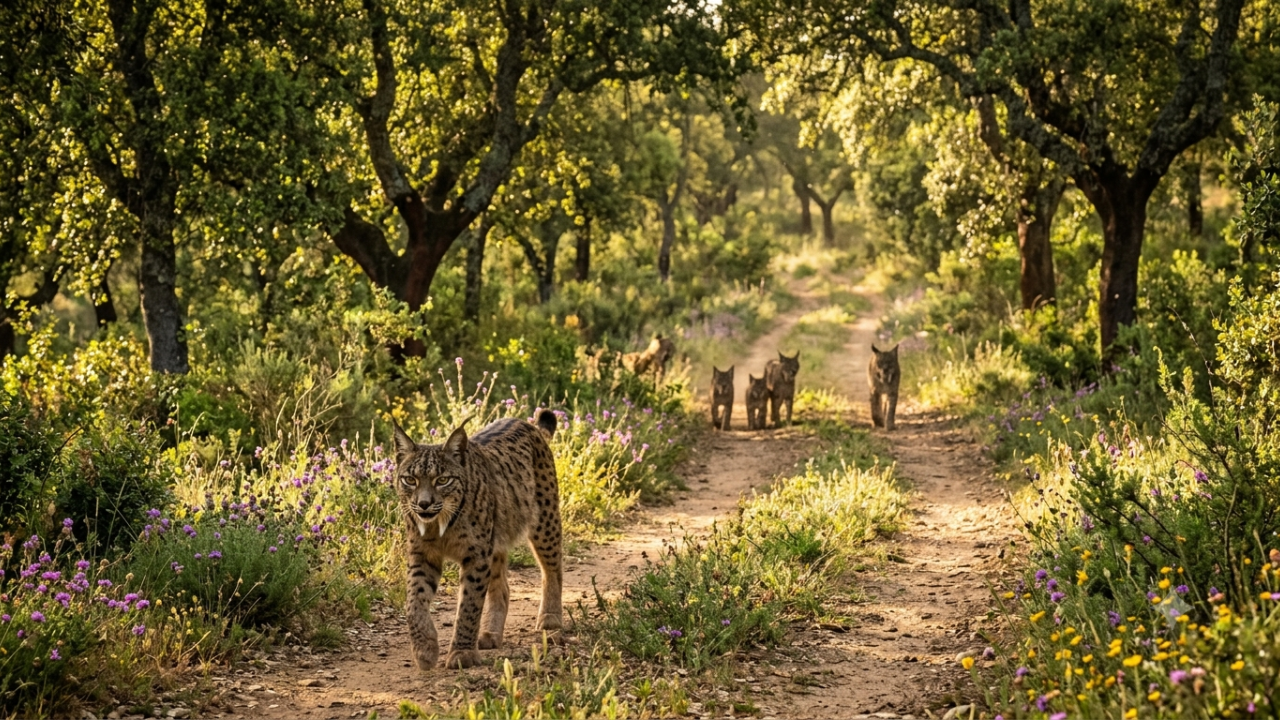
Saving the lynx meant dealing with something much smaller. European rabbits make up the main part of the Iberian lynx’s diet, so protecting lynx habitat without maintaining a reliable food supply would have left a major weakness in the recovery effort. Rabbit populations have been affected by disease as well as changes in land use, creating periods when food becomes scarce.Conservation work therefore extended beyond the predator itself. Protecting rabbit populations, restoring vegetation and maintaining suitable Mediterranean habitat all became connected parts of the same effort.The restoration of scrub and forest areas has also helped rebuild landscapes capable of supporting prey species. That creates benefits beyond the lynx, since the same habitats provide shelter and resources for other animals and contribute to the wider functioning of Mediterranean ecosystems.
How ecological corridors helped the lynx move between territories
A growing population still needs somewhere to live. Fragmentation had left Iberian lynx populations separated by roads, developed land and altered landscapes. For a solitary territorial animal, those gaps can become a serious obstacle. They can restrict movement, make it harder for animals to establish new territories and reduce opportunities for breeding between different groups.Ecological corridors have been used to make those movements easier. Instead of treating each protected area as an isolated patch, conservation planning has increasingly focused on maintaining connections between suitable habitats.This has also brought road safety into the picture. Vehicle collisions remain one of the threats facing the species, particularly where animals have to cross transport routes while moving between territories.
The population has changed dramatically since 2001
The figures give a clearer sense of the recovery than any single reintroduction.There were 62 mature Iberian lynx in 2001. By 2022, that figure had reached 648. When young animals were included, the total population was estimated to be above 2,000.That increase was sufficient for the IUCN Red List to move the species from Endangered to Vulnerable. The change reflects a lower assessed risk of extinction, rather than the disappearance of the threats that caused the original decline.The distinction matters. A species can move away from the highest categories of extinction risk while still having a long way to go before its populations function normally across its former range. The Iberian lynx remains an example of that difference.
The lynx’s return marks progress, but not full recovery
Alongside its Red List reassessment, the Iberian lynx received its first IUCN Green Status assessment. The result placed the species in the category described as “Largely depleted”, with a Species Recovery Score of 22%. The measure looks beyond whether a species is currently threatened with extinction. It considers how far populations are from full ecological recovery and how conservation action has affected that position.According to IUCN, the assessment found that the lynx was absent from two of six spatial units considered, while it was present but not yet fully functional in the other four. So the recovery is real, but incomplete.The assessment also indicated that enough suitable habitat remains for the species to potentially reach full recovery over a much longer period, provided conservation work continues effectively. The projected timeframe is around 100 years.
Genetic diversity remains a concern
The small size of the historical population left another problem behind: genetics. When populations become very small and isolated, genetic diversity can decline. That can leave animals more vulnerable to disease and reduce their ability to adapt to changing conditions.This is why translocations have been used alongside breeding programmes. Moving animals between populations can help prevent groups from becoming too genetically isolated, while carefully managed captive breeding can support the wider population without allowing the breeding stock to become too narrow. The aim is not simply to increase the number of lynx visible in the landscape. The populations also need enough genetic variation to remain resilient.
Several threats have not gone away
Disease continues to affect European rabbit populations, creating an indirect risk for the lynx by reducing its principal food source. Changes in land use can compound that problem by altering the habitats on which rabbits depend.The lynx itself remains exposed to human-related mortality. Poaching and poisoning can kill animals directly, while roads present another persistent danger. Disease can also affect the cats, including illnesses that may be transmitted from domestic animals. Habitat fragmentation adds a less immediate but equally important pressure. When populations are separated, animals have fewer opportunities to disperse, find mates and occupy new territories. These pressures become particularly difficult for smaller populations, where the loss of even a few individuals can have a noticeable effect.
