For decades, the central question was whether India could design, build and launch increasingly complex spacecraft on its own. That question has been answered across multiple fronts, from indigenous launch vehicles and navigation systems to lunar and solar missions, autonomous docking and preparations for human spaceflight.The next question is harder: can India build enough technological, industrial and commercial depth to sustain those capabilities when a critical component is unavailable, a supply chain is disrupted or geopolitical tensions restrict access to foreign technology?That is where the idea of space sovereignty becomes important. Space sovereignty, in practical terms, means having the ability to design, build, launch, operate and protect critical space assets without being vulnerable to a single external supplier, technology or geopolitical pressure.It does not mean producing every component domestically or shutting out international partnerships.Rather, it means retaining control over technologies and infrastructure critical to national security, communications, navigation and strategic decision-making, while having enough domestic capability to replace or rebuild them when access is disrupted.
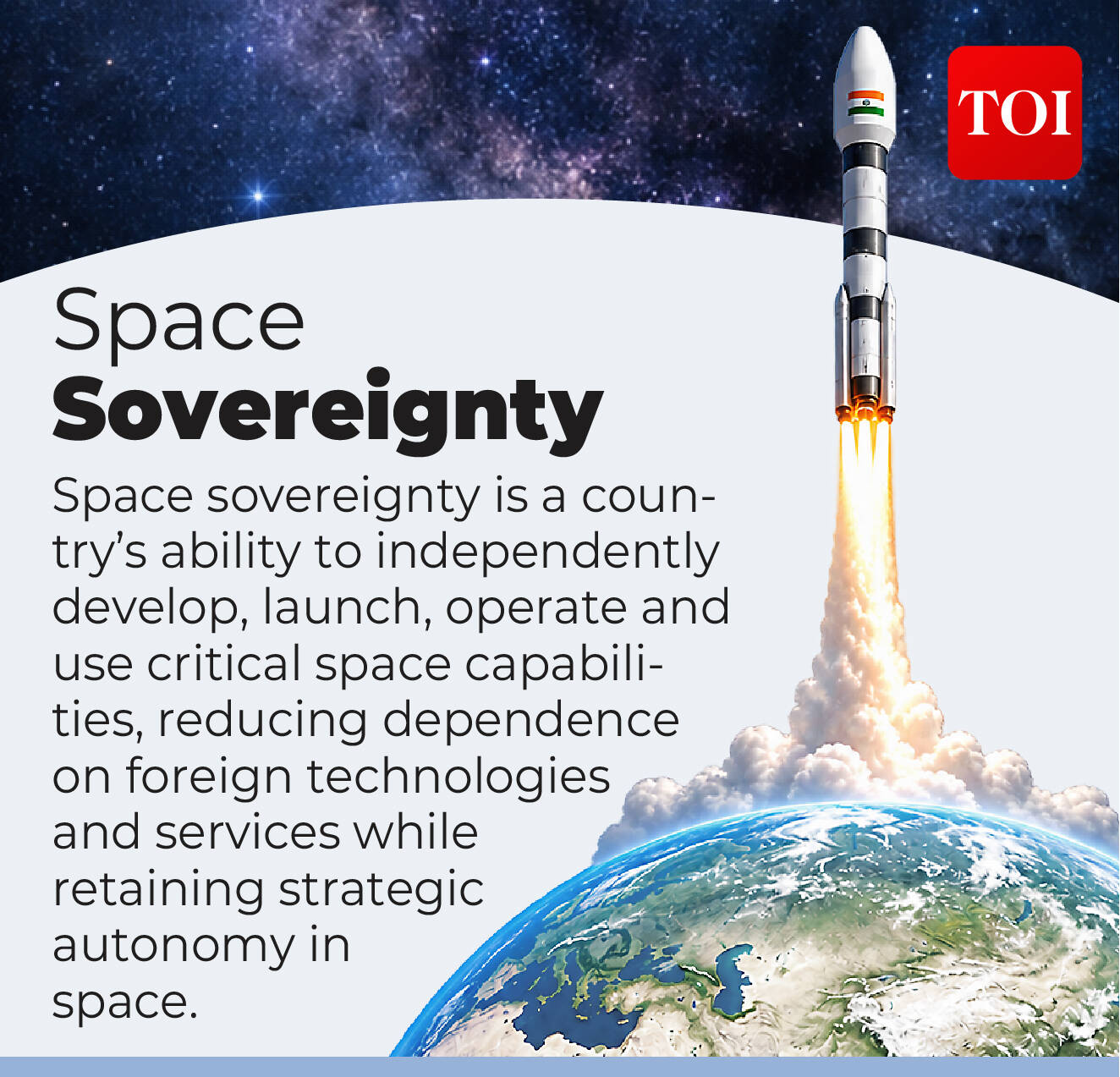
What ‘space sovereignty’ means
For India, that increasingly covers launch access, navigation, communications, strategic payloads, space-based data and the technologies that underpin them.
Space ecosystem that exists now
The scale of India’s transformation is visible in both its missions and the ecosystem around them.Chandrayaan-3’s 2023 soft landing near the lunar south pole demonstrated India’s ability to execute a complex lunar landing. Aditya-L1 extended that capability to solar observation, while SpaDeX in January 2025 demonstrated autonomous docking and undocking, a technology important for future human spaceflight, lunar sample-return and space-station missions.The jointly developed Nasa-Isro NISAR mission, launched in 2025, added another major international Earth-observation project to India’s portfolio. More recently, India has also demonstrated growing commercial launch capability, with 12 launch-vehicle missions between July 2023 and June 2026 carrying 11 Indian and nine international satellites.
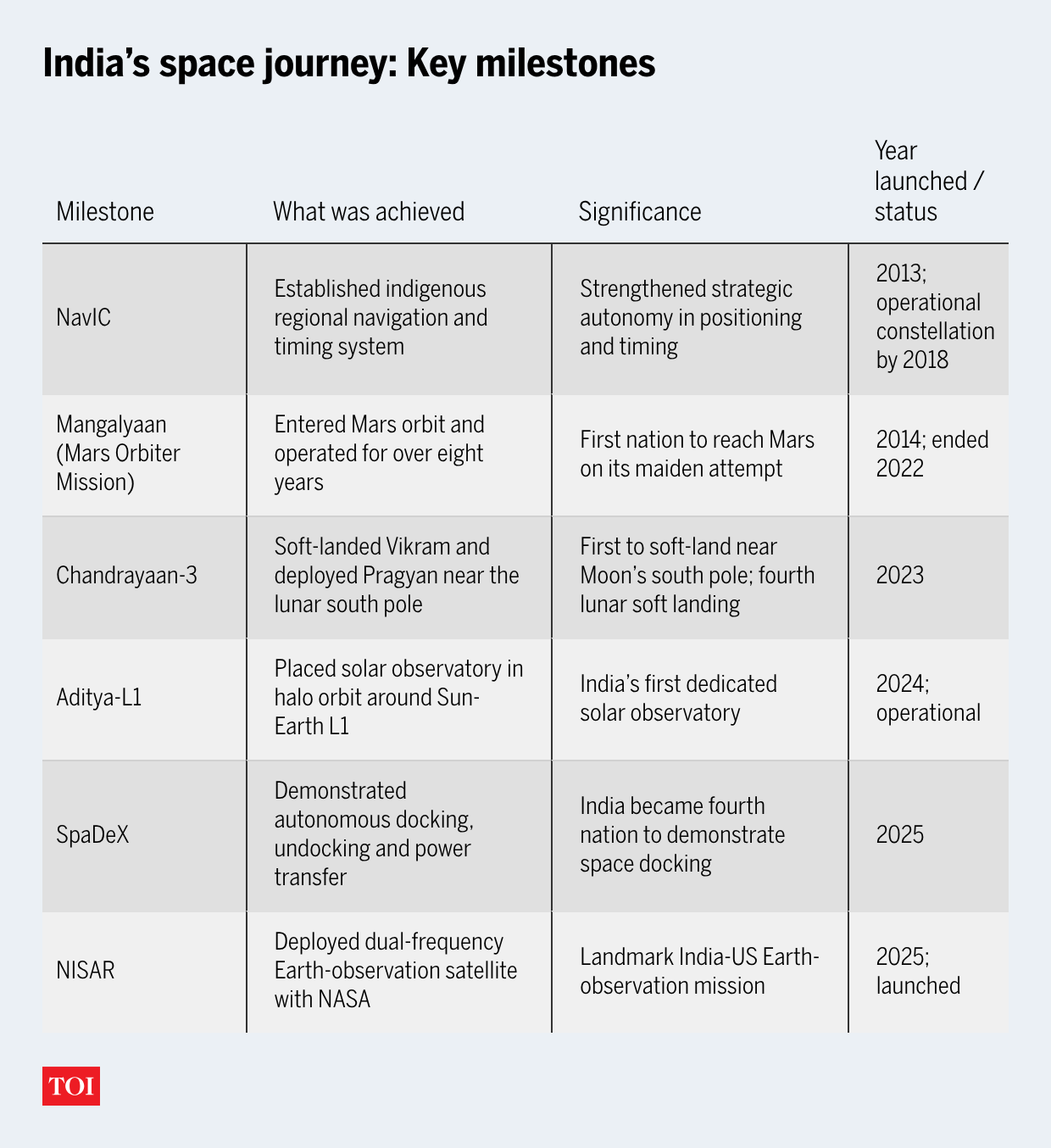
Key milestones for India
But a more consequential change may be happening on Earth.India had around 440 registered space startups by August, compared with one in 2014. Private investment in the sector had reached $618.5 million as of March 31, while IN-SPACe had authorised 113 activities involving 52 non-government entities. The Antariksh Venture Capital Fund, with a corpus of Rs 1,000 crore, is also now operational, and its investment committee has selected three startups.This represents a shift from a programme centred overwhelmingly on the government to an ecosystem in which private companies are expected to build launch systems, satellites, components and downstream applications.For investors, that is one of the most important structural changes. It also allows the government to share the burden of building India’s presence in space with the private sector.As Sreeram Ananthasayanam, partner, Deloitte India, who leads the firm’s space-sector practice, said, the next challenge is turning the policy opening into a commercially viable ecosystem. “India has opened the door of its space sector; now it needs customers walking through it. A licence doesn’t keep a space company alive, orders do. Government must become a steady buyer of Indian capability, and the space law needs to be promulgated to address issues on liability, insurance and IP,” he said.
India has opened the door of its space sector; now it needs customers walking through it.
Sreeram Ananthasayanam, partner, Deloitte India
“India’s edge is cost and engineering depth, with leading capacity in satellite subsystems, earth observation and analytics. The hurdle is at-scale flight heritage: global buyers pay for what has already worked in orbit. Indian companies need to fly early and often, and reduce their dependence on imported subsystems like detectors and space-grade electronics,” he added.The transition from a successful government space programme to a commercially sustainable industry is not complete. The question now is whether startups can turn technical demonstrations into repeatable products, build flight heritage and secure recurring contracts.Rathnakar Samavedam, investment director and managing partner at Hyderabad Angels Fund, which has investments in space-tech companies including Dhruva Space, outlined how the sector could develop.“The transformation in India’s space sector over the last three to four years represents a structural shift from a government-led monopoly to a private-market ecosystem. Historically, Isro was the sole architect, operator, and customer. Today, with the establishment of IN-SPACe, the introduction of the Indian Space Policy, and the liberalisation of Foreign Direct Investment (FDI) rules allowing up to 100% FDI in component segments and 74% automatic approval in satellite manufacturing, the regulatory risk profile for private capital has dropped.,” Samavedam explained.For investors, he added, the change is that they can increasingly evaluate space startups on execution, commercialisation and unit economics rather than only technological promise.“The policy opening created the top of the funnel; the next 36 months will determine which teams can translate technical validation into recurring commercial contracts,” he said.
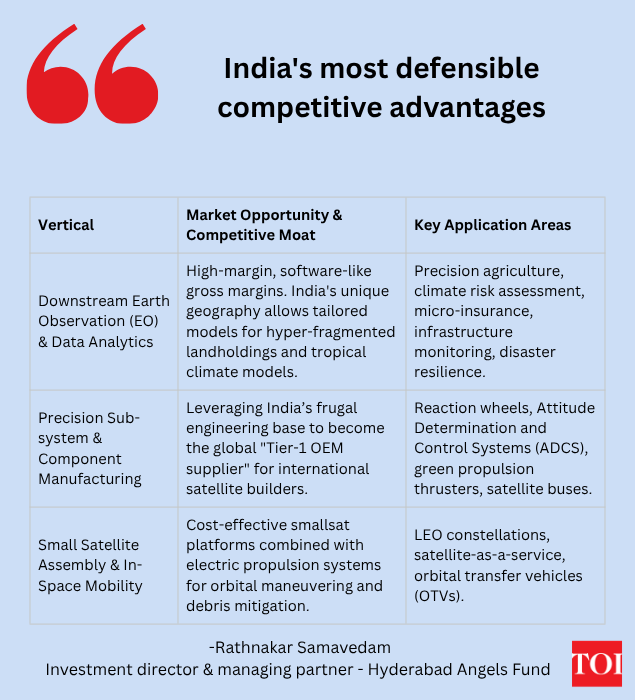
The advantages India has
But the funding pipeline is still uneven. While early-stage capital has expanded, Samavedam highlighted that genuine growth-stage opportunities remain limited, with only a smaller proportion of startups having moved into commercial monetisation.That makes the next phase less about the number of companies entering the sector and more about whether they can establish flight heritage, win repeat customers and scale production.
Define the next phase
India’s roadmap is also becoming more clearly defined.Under Space Vision 2047, the government is targeting the first module of the Bharatiya Antariksh Station by 2028, a fully established space station by 2035 and an Indian landing on the Moon by 2040. The approved programme also includes Chandrayaan-4, the Venus Orbiter Mission, the Next Generation Launch Vehicle and a third launch pad at Sriharikota.Each of these projects represents a different technological hurdle.Here are some of the missions and programmes expected to define India’s next phase of space sovereignty:
- Chandrayaan-4, targeted for 2027-28, is a major step in that direction. The sample-return mission will require India to master a chain of capabilities beyond a lunar landing, including lunar ascent, rendezvous and docking, sample transfer and controlled re-entry. Isro has also been developing the scientific and institutional ecosystem needed to analyse returned lunar samples, bringing India closer to the capabilities required for more complex lunar missions.
- Gaganyaan and the Bharatiya Antariksh Station represent another major test. Gaganyaan is designed to demonstrate India’s ability to send and safely return a crew of three, while BAS-01, targeted for 2028, is the first building block of a planned five-module station that is expected to be fully operational by 2035. The station will require India to develop capabilities in long-duration human spaceflight, life support, docking, in-orbit operations and microgravity research. Isro has already begun work on Indian microgravity experiments for BAS, indicating that the programme is being built not merely as a station but as a platform for sustained Indian scientific activity in orbit.
- The Venus Orbiter Mission, targeted for March 2028, represents another kind of technological sovereignty: the ability to operate in environments substantially more demanding than near-Earth space. The mission will require advanced aerobraking and thermal-management capabilities while studying Venus’ geology, atmosphere and ionosphere. These technologies would expand India’s ability to design and operate spacecraft for increasingly difficult deep-space environments.
- The Next Generation Launch Vehicle (NGLV) addresses another fundamental element of sovereignty: reliable and scalable access to space. The proposed vehicle is designed to carry up to 30 tonnes to low Earth orbit and incorporates a reusable first stage. The push is therefore not simply for a bigger rocket, but towards higher payload capacity, greater launch frequency, lower costs and reusable access to orbit. The government has explicitly linked NGLV to the expanded national vision that includes BAS and an eventual Indian crewed lunar landing.
- Additionally, launch infrastructure itself is being expanded. A third launch pad at Sriharikota is being developed for next-generation vehicles, while the SSLV Launch Complex at Kulasekarapattinam is being established as India’s second rocket launch site. The latter is expected to be commissioned during FY2026-27, with SSLV launches expected from there from 2027-28.
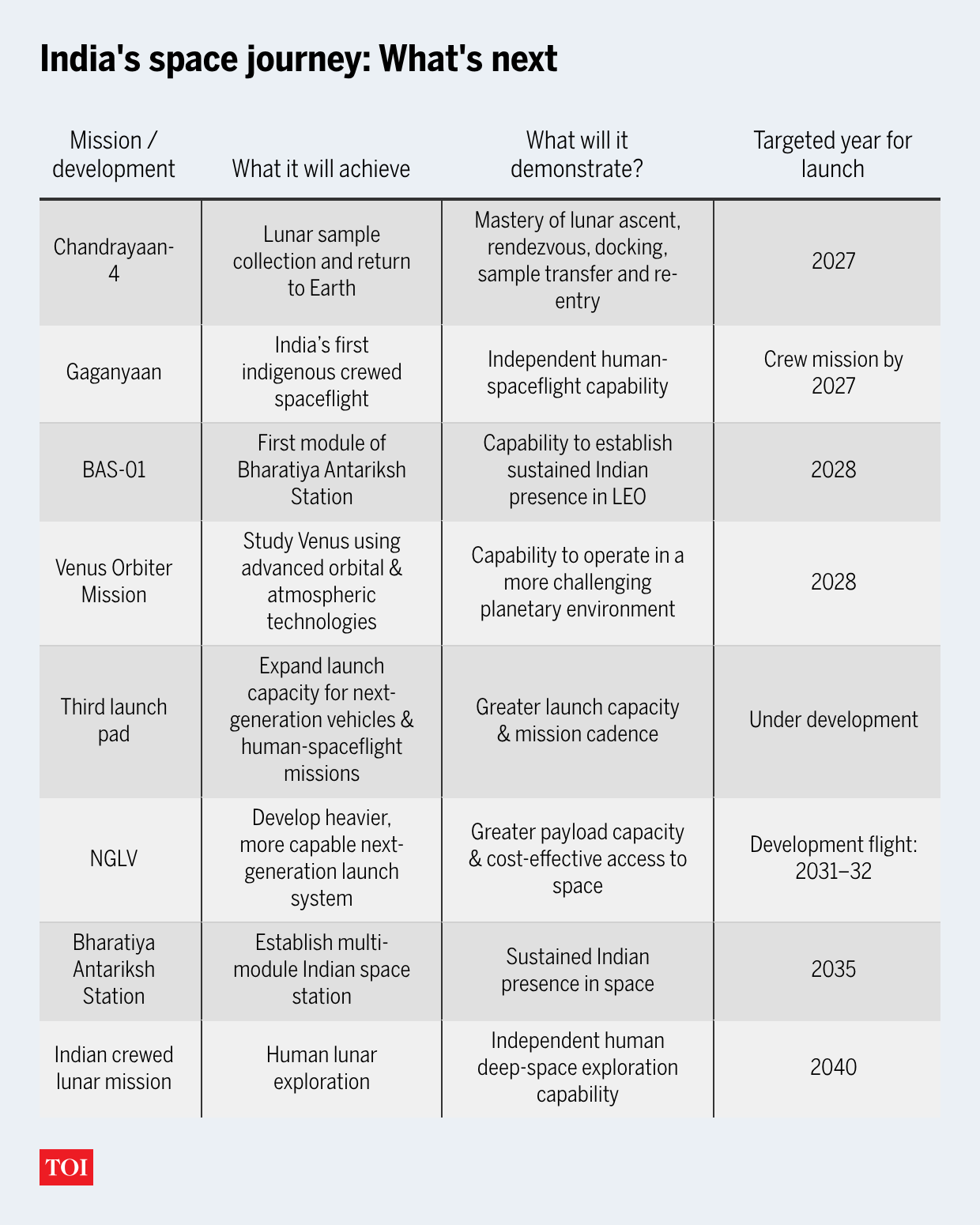
What’s next for India
All these are not simply a collection of missions. Together, they represent the technological building blocks for a more independent space architecture: heavy lift, reusability, orbital docking, human spaceflight, lunar sample return, deep-space operations and sustained presence in orbit.Krishna Dev Pathak, an investment banker and advisor to early-stage startups including spacetech, said the sector is now entering a phase where technological capability alone will not be enough.“The first phase was about opening the sector and demonstrating what Indian companies could build. The next phase is about building the depth, scale and commercial ecosystem around those capabilities,” he said.That means developing a larger base of specialised suppliers and manufacturers, improving testing and production capacity, and creating businesses that can move beyond government-led demand. Pathak said India’s opportunity extends beyond rockets to satellite manufacturing, space-grade components, propulsion, ground infrastructure, Earth observation and geospatial intelligence.“Over the next 5–10 years, I think some of India’s strongest space companies could emerge from the less visible layers of the ecosystem, components, manufacturing, data and specialised software, where Indian engineering and cost advantages can potentially translate into globally competitive products. Ultimately, the opportunity is not just to build for India’s space programme, but to build capabilities in India that the world wants to buy,” he added.
The opportunity is not just to build for India’s space programme, but to build capabilities in India that the world wants to buy.
Krishna Dev Pathak, Investment Banker, spacetech startup investor
The gaps that remain
India’s achievements, while significant, have also created a new problem: the country can increasingly execute complex missions, but the depth of the underlying supply chain does not yet match the ambition.“India’s defining achievement has been end-to-end mission capability. We can design a satellite, build its launch vehicle, place it in orbit and operate it through an indigenous ground network. Cryogenic propulsion, reliable launch vehicles, Earth-observation platforms and NavIC were major steps in that journey,” said Gurpreet Singh, former Scientist-SF at Isro’s U R Rao Satellite Centre and Math Lead at Newton School of Technology.Reflecting on the challenges ahead, he added, “The next challenge is component-level self-reliance. Space-grade chips, radiation-hardened electronics, atomic clocks, detectors and advanced sensors remain potential chokepoints. In space, one unavailable component can hold up an entire mission. The real test is whether we can replace, replenish and return to flight quickly without an external dependency deciding our timeline.“That distinction is critical as self-reliance does not mean isloation ,as Singh explained. A mission may be designed and assembled in India but still depend on imported radiation-hardened electronics, specialised sensors, detectors, atomic clocks or other components.
Sovereignty also should not be confused with isolation. India should collaborate internationally, but from a position of capability and choice.
Gurpreet Singh, Math Lead, Newton School of Technology; former Scientist-SF, U R Rao Satellite Centre, ISRO
The government has begun addressing this through technology transfers, funding and manufacturing initiatives. NSIL has signed 118 technology-transfer agreements covering 83 Isro/Department of Space technologies, while the government has introduced a Rs 500-crore Technology Adoption Fund and a Rs 1,000-crore venture fund for the private ecosystem.But technology ownership alone will not create sovereignty. Those technologies must be manufactured at scale, repeatedly tested, qualified for flight and supported by a domestic supplier base.That is why the next phase of India’s space story is likely to be less about proving that India can accomplish one extraordinary mission and more about whether it can turn those capabilities into an industrial system that can keep producing them.
